No Code XML Conversion to Oracle

In a previous post we demonstrated how to use Flexter to convert XML data into TSV files.
This was just an introduction demonstrating some basic features of Flexter including concepts around XML schema normalization and optimization.
Use Flexter to turn XML and JSON into Valuable Insights
- 100% Automation
- 0% Coding
Converting XML into an Oracle Database
This time we are going to show you a more interesting and common use case. Querying XML in the context of data analytics. Our requirement is to create some reports or dashboards over data in XML files. We could use XQuery to do this. Unfortunately, none of the BI or visualisation tools really support this. XQuery is really awkward to use and most XQuery engines don’t have support for running queries across multiple XML files. They also lack a query optimizer and as a result queries don’t perform well. Finally, very few developers possess XQuery skills. A much better approach is to convert the XML files into a relational schema in a database and use SQL, the lingua franca for data, to query it.
Loading XML into the the Oracle database using Flexter is pretty easy. Let’s take the same pain.001.001.03 schema and data example we have used before. The first step is the same: analyse the XML schema and extract the metadata to create the target schema. As we’ve done that already in the first post I’m going to skip it.
Instead we reuse the metadata and point Flexter to our Oracle database to create the target schema.
regsch {psch_name=>'SepaDB', jdbc_url=>'jdbc:oracle:thin:@//oracledemo.sonra.io:11521/orcl', login=>'edw_staging'}
provide password: *******
# target schema created:
           out:  420
           org:  1

Target schema registered.
Loading XML to the Oracle database
That’s it – we are now ready to process the data. It’s as simple as running Flexter’s xml2er command line tool.
-x 1496 this is to specify what is the expected layout of the XML (we processed schema in previous post)
-l 420 this is to specify where to write the output (we’ve just registered the staging schema in Oracle)
xml2er -x 1496 -l 420 tmp/sepa/pain.001.001.03.xmls.zip
18:21:09.444  INFO  Registering new job
18:21:10.462  INFO  Loading metadata
[Stage 1:=>                                                       (6 + 1) / 200]
[Stage 1:=>                                                       (7 + 1) / 200]
[Stage 1:==>                                                      (9 + 1) / 200]
[Stage 1:====>                                                   (15 + 1) / 200]
[Stage 1:=====>                                                  (20 + 1) / 200]
[Stage 1:=======>                                                (27 + 1) / 200]
[Stage 1:==========>                                             (36 + 1) / 200]
[Stage 1:============>                                           (44 + 1) / 200]
[Stage 1:==============>                                         (50 + 1) / 200]
[Stage 1:================>                                       (59 + 1) / 200]
[Stage 1:===================>                                    (69 + 1) / 200]
[Stage 1:=====================>                                  (78 + 1) / 200]
[Stage 1:========================>                               (88 + 1) / 200]
[Stage 1:==========================>                             (93 + 1) / 200]
[Stage 1:=============================>                         (106 + 1) / 200]
[Stage 1:=================================>                     (120 + 1) / 200]
[Stage 1:====================================>                  (134 + 1) / 200]
[Stage 1:========================================>              (147 + 1) / 200]
[Stage 1:==========================================>            (155 + 1) / 200]
[Stage 1:=============================================>         (166 + 1) / 200]
[Stage 1:=================================================>     (180 + 1) / 200]
[Stage 1:=====================================================> (195 + 1) / 200]
18:21:22.838  INFO  Parsing data
18:21:28.197  INFO  calculating data
18:21:33.275  INFO  creating table GrpHdr_InitgPty_Id_OrgId_Othr
18:21:33.290  INFO  creating table GrpHdr_InitgPty_Id_PrvtId_Othr
18:21:33.291  INFO  creating table Document
18:21:33.296  INFO  creating table CdtTrfTxInf_Cdtr_Id_OrgId_Othr
18:21:33.296  INFO  creating table CdtTrfTxInf
18:21:33.318  INFO  creating table Cdtr_PstlAdr_AdrLine
18:21:33.319  INFO  creating table Strd
18:21:33.320  INFO  creating table Ustrd
18:21:33.320  INFO  creating table UltmtCdtr_Id_OrgId_Othr
18:21:33.320  INFO  creating table PmtInf_Dbtr_Id_OrgId_Othr
18:21:33.320  INFO  creating table PmtInf_Dbtr_PstlAdr_AdrLine
18:21:33.320  INFO  creating table PmtInf
18:21:33.323  INFO  creating table PmtInf_UltmtDbtr_Id_OrgId_Othr
18:21:37.564  INFO  writing tables
18:21:37.568  INFO  writing table GrpHdr_InitgPty_Id_OrgId_Othr
18:21:39.688  INFO  writing table GrpHdr_InitgPty_Id_PrvtId_Othr
18:21:39.952  INFO  writing table Document
18:21:40.269  INFO  writing table CdtTrfTxInf_Cdtr_Id_OrgId_Othr
18:21:40.480  INFO  writing table CdtTrfTxInf
18:21:40.936  INFO  writing table Cdtr_PstlAdr_AdrLine
18:21:41.156  INFO  writing table Strd
18:21:41.396  INFO  writing table Ustrd
18:21:41.641  INFO  writing table UltmtCdtr_Id_OrgId_Othr
18:21:41.847  INFO  writing table PmtInf_Dbtr_Id_OrgId_Othr
18:21:42.066  INFO  writing table PmtInf_Dbtr_PstlAdr_AdrLine
18:21:42.297  INFO  writing table PmtInf
18:21:42.585  INFO  writing table PmtInf_UltmtDbtr_Id_OrgId_Othr
18:21:43.041  INFO  calculating statistics
18:21:43.359  INFO  writing statistics rows
18:21:43.719  INFO  Registering success of job 3750
18:21:43.732  INFO  Finished successfully in 58030 milliseconds
# schema
           xml:  1496
       logical:  420
           org:  1
           job:  3750
# statistics
          load:  37137 ms
         parse:  5359 ms
        schema:  9366 ms
         write:  5210 ms
         stats:  946 ms
        xpaths:  515
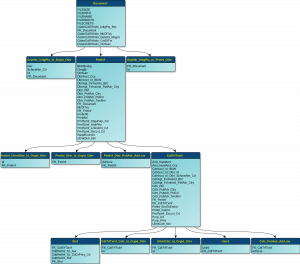
As per our previous post when we were parsing XML into TSV files we have created the same 13 datasets. This time as regular Oracle tables.
Pain of loading XML to a Database
Pretty simple, right? Compare this to the manual steps it takes to load the data into a database:
- the XML needs to be manually normalized
- the target tables need to be modelled in the database
- table relationships need to be established and created
- surrogate keys for parent-child relationships need to be generated.
- keys need to be globally unique (no conflicts when loading multiple XML files)
- each target table needs to be mapped manually
- each mapping needs to be orchestrated into a data flow
- each source XML file needs to be loaded into the target schema
As you can imagine this is very labour intensive and boring. It also requires a lot of time to implement.
Benefits of using Flexter to load XML to a Database
With Flexter the whole process is quick and fully automated. Developers can focus on creating real value, e.g. writing the SQL to generate reports or loading and integrating the data into a data warehouse.
What makes the analysis or downstream development even easier and faster is the fact that the number of the tables has been highly reduced by applying some of Flexter’s optimization algorithms. From 940 possible XML entities we went down to just 13 relational tables populated with data:
|
XSD |
xsd2er |
XML map (940 entities) |
calcmap |
logical Layout (58 tables) |
xml2er |
Target (13 tables) |
|
→ |
→ |
→ | ||||
|
schema |
layout |
xml data |
This simply means less (a lot less!) tables to focus on when working with the output:
less tables → less joins → optimized performance
In terms of supported target platforms Flexter works with multiple RDBMS engines, e.g. Oracle, DB2, Teradata etc.. Besides TSV files, Flexter can also generate Parquet files which can be loaded into your Data Lake, and read through Hive, Impala, Spark, Drill, Flink or a similar data processing engine.
NDC. A more complex schema example
940 XML elements seems like a lot. In fact most industry XML standards contain a lot more. Their schemas are often highly modularized and with multiple XSD files that cross-reference each other. In those complex XML schemas we typically have one or two XSD files that contain all of the reusable types – reference data in other words. The other XSDs typically contain different types of transactions or messages, e.g. bookings or orders.
To illustrate this better, let’s take a look at the NDC (New Distribution Capability) XML standard. This standard is developed by IATA.
The list of XSD files and modules is quite comprehensive (60!):
ls -lS Flexter/data/NDC/ndc-XMLSchemas-master/*.xsd
-rwxr-xr-x 1 flexter 1264395 Jan 20  2016 edist_commontypes.xsd
-rwxr-xr-x 1 flexter  149654 Jan 20  2016 edist_structures.xsd
-rwxr-xr-x 1 flexter   66901 Jan 20  2016 ItinReshopRS.xsd
-rwxr-xr-x 1 flexter   37806 Jan 20  2016 OrderListRQ.xsd
-rwxr-xr-x 1 flexter   33067 Jan 20  2016 OrderChangeRQ.xsd
-rwxr-xr-x 1 flexter   31845 Jan 20  2016 OrderCreateRQ.xsd
-rwxr-xr-x 1 flexter   31242 Jan 20  2016 OrderRetrieveRQ.xsd
-rwxr-xr-x 1 flexter   30388 Jan 20  2016 OrderViewRS.xsd
-rwxr-xr-x 1 flexter   29101 Jan 20  2016 AirShoppingRQ.xsd
-rwxr-xr-x 1 flexter   19996 Jan 20  2016 FlightPriceRS.xsd
-rwxr-xr-x 1 flexter   19681 Jan 20  2016 AirShoppingRS.xsd
-rwxr-xr-x 1 flexter   19128 Jan 20  2016 ItinReshopRQ.xsd
-rwxr-xr-x 1 flexter   17494 Jan 20  2016 ShopProductRS.xsd
-rwxr-xr-x 1 flexter   16877 Jan 20  2016 BaggageChargesRS.xsd
-rwxr-xr-x 1 flexter   16623 Jan 20  2016 BaggageChargesRQ.xsd
-rwxr-xr-x 1 flexter   16533 Jan 20  2016 OrderHistoryRS.xsd
-rwxr-xr-x 1 flexter   15739 Jan 20  2016 SeatAvailabilityRS.xsd
-rwxr-xr-x 1 flexter   15494 Jan 20  2016 ServicePriceRQ.xsd
-rwxr-xr-x 1 flexter   15196 Jan 20  2016 SeatAvailabilityRQ.xsd
-rwxr-xr-x 1 flexter   14971 Jan 20  2016 ServiceListRQ.xsd
-rwxr-xr-x 1 flexter   14647 Jan 20  2016 ServicePriceRS.xsd
-rwxr-xr-x 1 flexter   14420 Jan 20  2016 FlightPriceRQ.xsd
-rwxr-xr-x 1 flexter   14330 Jan 20  2016 ServiceListRS.xsd
-rwxr-xr-x 1 flexter   14092 Jan 20  2016 BaggageAllowanceRS.xsd
-rwxr-xr-x 1 flexter   14062 Jan 20  2016 OrderHistoryNotif.xsd
-rwxr-xr-x 1 flexter   13938 Jan 20  2016 BaggageAllowanceRQ.xsd
-rwxr-xr-x 1 flexter   13755 Jan 20  2016 AirDocDisplayRS.xsd
-rwxr-xr-x 1 flexter   13620 Jan 20  2016 OrderChangeNotif.xsd
-rwxr-xr-x 1 flexter   13604 Jan 20  2016 BaggageListRQ.xsd
-rwxr-xr-x 1 flexter   12418 Jan 20  2016 BaggageListRS.xsd
-rwxr-xr-x 1 flexter   11231 Jan 20  2016 AirDocRefundRS.xsd
-rwxr-xr-x 1 flexter   11201 Jan 20  2016 InvGuaranteeRQ.xsd
-rwxr-xr-x 1 flexter   11113 Jan 20  2016 ShopProductRQ.xsd
-rwxr-xr-x 1 flexter   10956 Jan 20  2016 xmldsig-core-schema.xsd
-rwxr-xr-x 1 flexter   10680 Jan 20  2016 FileRetrieveRS.xsd
-rwxr-xr-x 1 flexter   10501 Jan 20  2016 OrderCancelRS.xsd
-rwxr-xr-x 1 flexter   10197 Jan 20  2016 CustomerInputRS.xsd
-rwxr-xr-x 1 flexter   10132 Jan 20  2016 OrderListRS.xsd
-rwxr-xr-x 1 flexter	9442 Jan 20  2016 InvGuaranteeRS.xsd
-rwxr-xr-x 1 flexter	8450 Jan 20  2016 CustomerInputRQ.xsd
-rwxr-xr-x 1 flexter	6513 Jan 20  2016 FareRulesRQ.xsd
-rwxr-xr-x 1 flexter	6084 Jan 20  2016 FareRulesRS.xsd
-rwxr-xr-x 1 flexter	6014 Jan 20  2016 AirDocCancelRS.xsd
-rwxr-xr-x 1 flexter	5963 Jan 20  2016 AirDocHistoryRS.xsd
-rwxr-xr-x 1 flexter	5695 Jan 20  2016 AirDocVoidRS.xsd
-rwxr-xr-x 1 flexter	5563 Jan 20  2016 InvReleaseNotif.xsd
-rwxr-xr-x 1 flexter	5039 Jan 20  2016 AirDocIssueRQ.xsd
-rwxr-xr-x 1 flexter	4913 Jan 20  2016 AirDocExchangeRQ.xsd
-rwxr-xr-x 1 flexter	4719 Jan 20  2016 AirDocDisplayRQ.xsd
-rwxr-xr-x 1 flexter	4372 Jan 20  2016 FileRetrieveRQ.xsd
-rwxr-xr-x 1 flexter	4009 Jan 20  2016 OrderRulesRS.xsd
-rwxr-xr-x 1 flexter	3880 Jan 20  2016 AirDocCancelRQ.xsd
-rwxr-xr-x 1 flexter	3800 Jan 20  2016 AirDocRefundRQ.xsd
-rwxr-xr-x 1 flexter	3661 Jan 20  2016 OrderCancelRQ.xsd
-rwxr-xr-x 1 flexter	3616 Jan 20  2016 OrderRulesRQ.xsd
-rwxr-xr-x 1 flexter	3449 Jan 20  2016 OrderHistoryRQ.xsd
-rwxr-xr-x 1 flexter	3258 Jan 20  2016 _GlobalNamingTest.xsd
-rwxr-xr-x 1 flexter	2237 Jan 20  2016 Acknowledgement.xsd
-rwxr-xr-x 1 flexter	2223 Jan 20  2016 AirDocVoidRQ.xsd
-rwxr-xr-x 1 flexter	2156 Jan 20  2016 AirDocHistoryRQ.xsd
We can use Flexter to show us all of the root elements across the 60 XSDs. From this information we get an overview on the type of messages and data we are dealing with. Let’s run the Flexter xsd2er tool with a couple of extra options:
xsd2er -s -RF /mapr/prd.hw.sonra.io/tmp/ndc/
-s Skip writing to Flexter’s metadata repository (dry run)
-R Unreferenced elements will be considered roots
-F Unreferenced files will be considered root files
For each XSD, Flexter prints out the root elements and types that were detected
  ⋮
11:30:37.201  INFO  Root elements:
  Acknowledgement.xsd
  - Acknowledgement
  edist_structures.xsd
  - MetadataKey
  - DateTime
  - Day
  - MonthYear
  - ShortDate
  - Timestamp
  - Year
  - YearMonth
  FileRetrieveRS.xsd
  - FileRetrieveRS
  - MediaDescriptions
  FlightPriceRQ.xsd
  - FlightPriceRQ
  FlightPriceRS.xsd
  - FlightPriceRS
  edist_commontypes.xsd
  - ISO_CurrencyCode
  - MessageCurrencies
  - MediaID
  - MediaAttachment
  - CampaignReferral
  - PaymentForms
  - AwardRedemption
  - AdjustedFixedAmount
  ⋮
As you can see, the edist_comontypes.xsd contains a lot of different types such as Currencies or PaymentForms. These types are the reusable reference data of the standard. The output from Flexter (represented in the diagram below) visualises this information and gives us a nice overview of the standard in general. For each XSD file we get a list of the available types.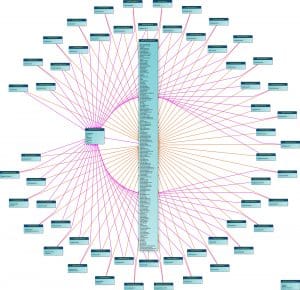
XML Processing with the NDC Standard
Let’s see Flexter in action. We have collected some sample data for the FlightPriceRS type, which if you remember from the output above is one of the XSD files. As usual, we analyse the schema in a first step. We will use an extra filter to only process the FlightPriceRS type as this is the one that we have sample data for.
xsd2er -r FlightPriceRS /mapr/prd.hw.sonra.io/tmp/ndc/
   ⋮
06:56:34.254  INFO  Root elements:
  FlightPriceRS.xsd
  - FlightPriceRS
  - PricedFlightOffer
06:56:34.260  INFO  Building metatada
06:56:34.703  INFO  Writing metatada
06:56:49.946  INFO  Registering success of job 117
06:56:50.007  INFO  Finished successfully in 21178 milliseconds
# schema
  	schemaXml:  36
        	org:  1
        	job:  117
   elements: 4012
# statistics
       	load:  2605 ms
      	parse:  2823 ms
      	build:  447 ms
      	write:  15244 ms
This resulted in 4012 entry elements. The root element filter for FlightPriceRS we applied above reduced the number of elements. Out of curiosity, we analysed the whole XSD (all 60 files and not just the FlightPriceRS XSD) and this resulted in a whopping 219k XML elements. I won’t make an attempt to visualise that here 😉
Calculating the target schema and mapping is next on our list. We will use both of Flexter’s optimization modes
Elevation. This optimization detects one-to-one relationships and merges them into parent entities
Reusability. This optimization de-duplicates the occurrence of reference tables. Without this optimization we would get a separate table each time a reference type is used. (single, multi-parent table if the type referenced multiple times)
calcmap -x 36 -l 421 {true, true}
Let’s process the sample data straight away:
xml2er -x 36 -l 421 /mapr/dev.sonra.io/tmp/ndc/NDC.FlightPriceRS/
this time we will store the result into Flexter’s metadata repository.
   ⋮
11:35:17.573  INFO  writing tables
11:35:17.577  INFO  writing table FlightPriceRS
11:35:26.929  INFO  writing table PricedFlightOfferAssocType
11:35:27.198  INFO  writing table FlightSegmentReference
11:35:27.394  INFO  writing table FareComponentType
11:35:27.936  INFO  writing table Remark
11:35:28.149  INFO  writing table Detail1
11:35:28.398  INFO  writing table Amount
11:35:28.643  INFO  writing table SegmentReferences
11:35:28.845  INFO  writing table Media2
11:35:29.104  INFO  writing table Flight
11:35:29.406  INFO  writing table AnonymousTraveler
11:35:29.636  INFO  writing table OriginDestination
11:35:29.850  INFO  writing table FlightSegment
11:35:30.227  INFO  writing table Service
11:35:30.787  INFO  writing table Descriptions_Description1
11:35:31.041  INFO  writing table Associations
11:35:31.291  INFO  writing table Price
11:35:31.612  INFO  writing table PriceClass
11:35:31.884  INFO  writing table PricedFlightOffer
11:35:32.229  INFO  writing table PricedFlightOffer_OfferPrice
11:35:32.631  INFO  writing table OtherMetadata
11:35:32.837  INFO  writing table AugPointType
11:35:33.105  INFO  writing table DescriptionMetadata
11:35:33.349  INFO  writing table CurrencyMetadata
11:35:34.173  INFO  calculating statistics
11:35:34.833  INFO  Removing RDD 124 from persistence list
11:35:34.859  INFO  writing new xpaths
11:35:35.291  INFO  writing statistics rows
11:35:35.909  INFO  Registering success of job 3823
11:35:35.928  INFO  Finished successfully
# schema
       	xml:  1507
   	logical:  439
       	org:  1
       	job:  3823
Let’s focus on the output now. Flexter was able to reduce the target schema to just 24 tables!. Flexter’s optimizations did a great job. We now have 99.5% less tables to query, join and analyse.
If we compare the input schema of the XSD to the final target schema in the database we see the difference straight away. Pretty impressive.
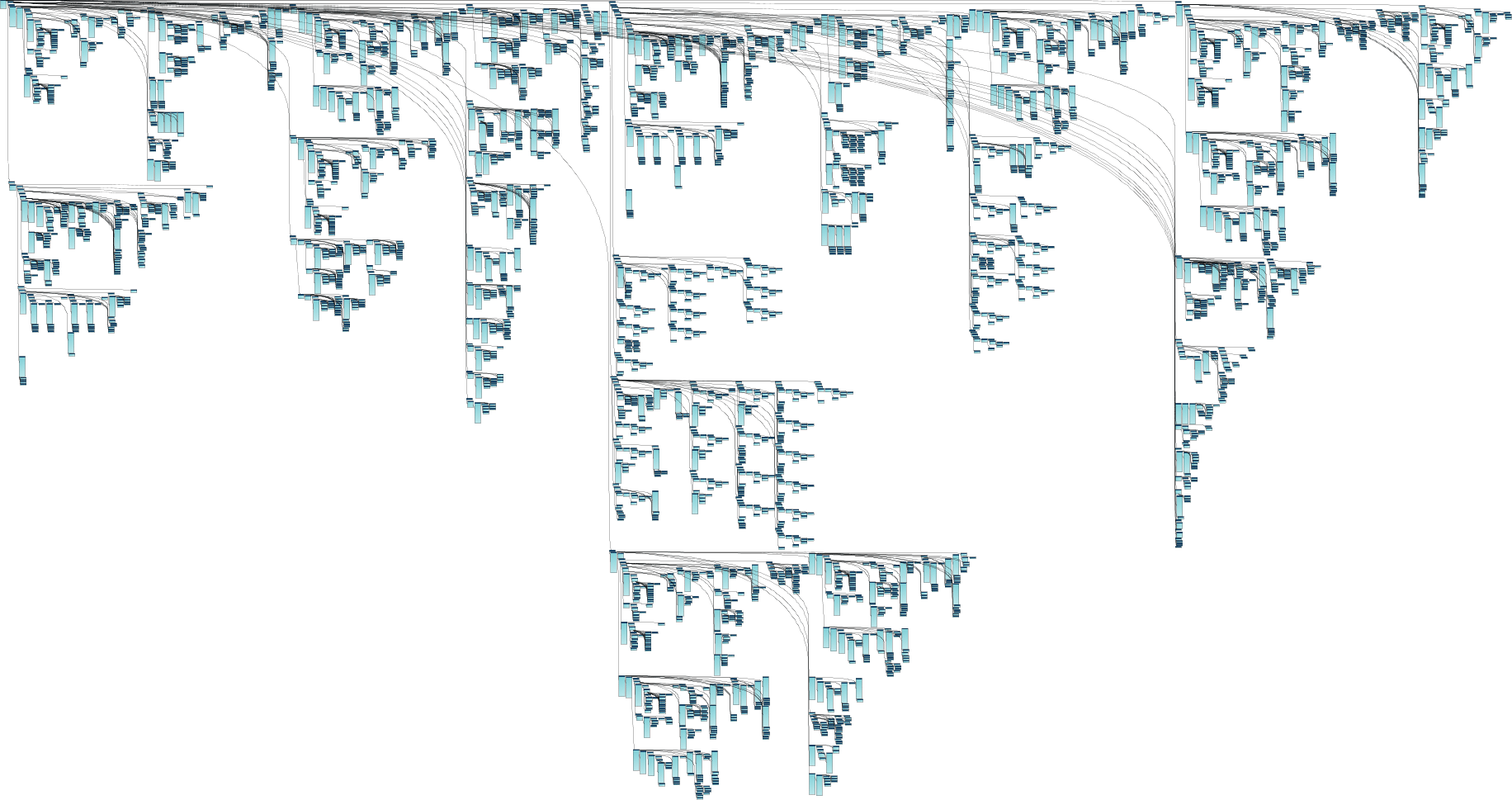
Source Schema (if we don’t apply any optimizations this would be the Target Schema as well)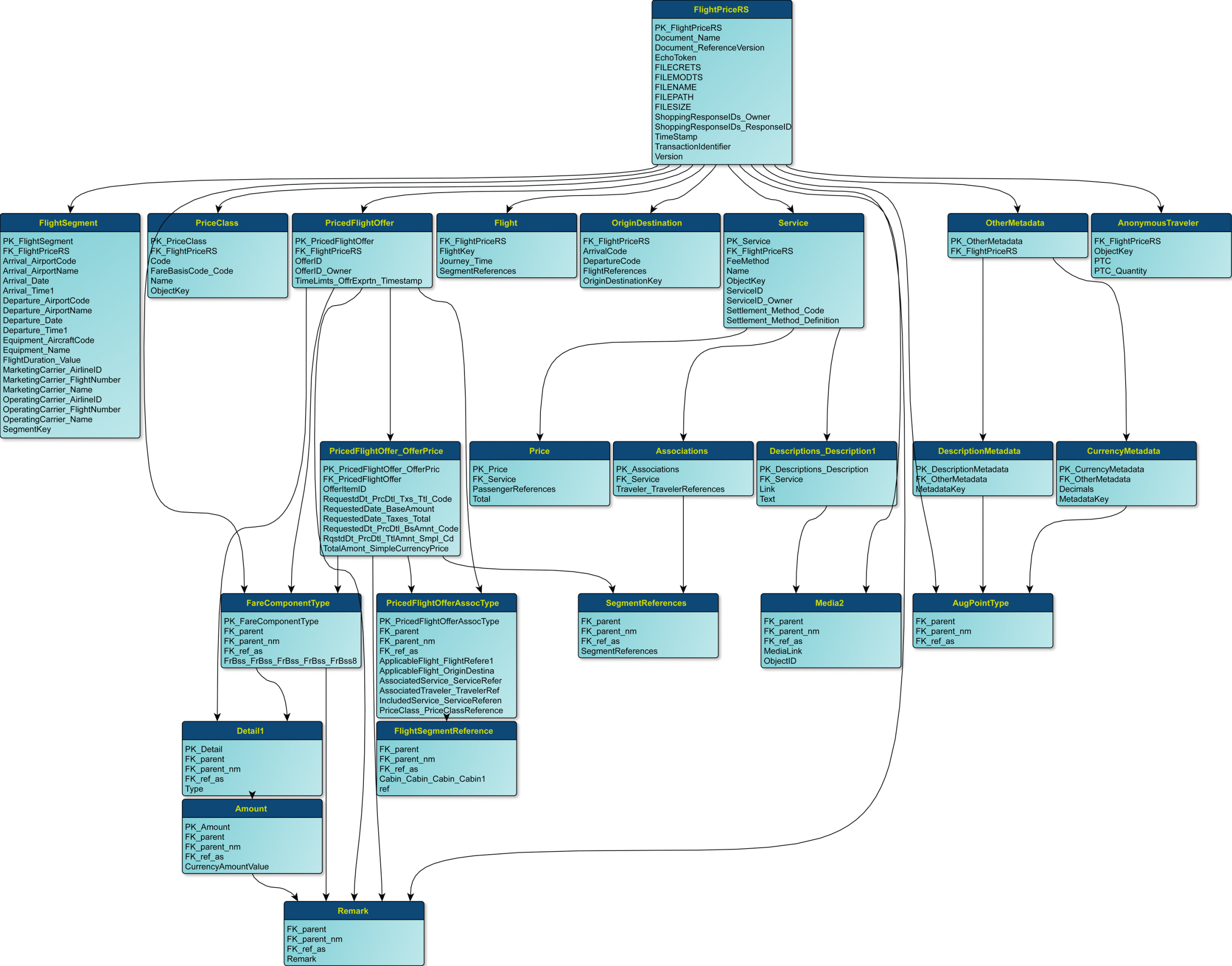
Flexter Data Lineage. From XML Source elements to Oracle table columns
You might think that this is pretty awesome. But hold on, there is even more. If you check the staging schema generated by Flexter you will notice that tables and columns are commented. The commentary provides source to target mappings, e.g. we can see that column JOURNEY_TIME comes from /FlightPriceRS/DataLists/FlightList/Flight/Journey/Time.
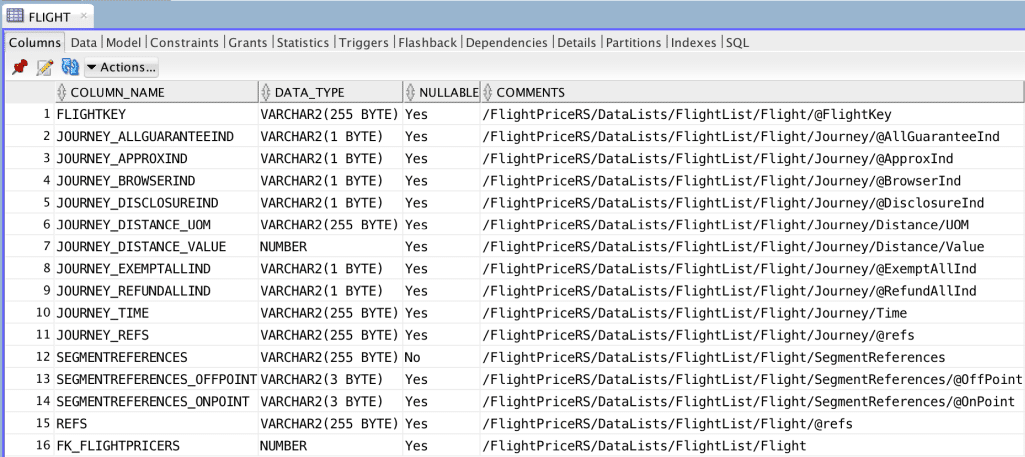
Flexter also provides full documentation on data lineage and the mappings:
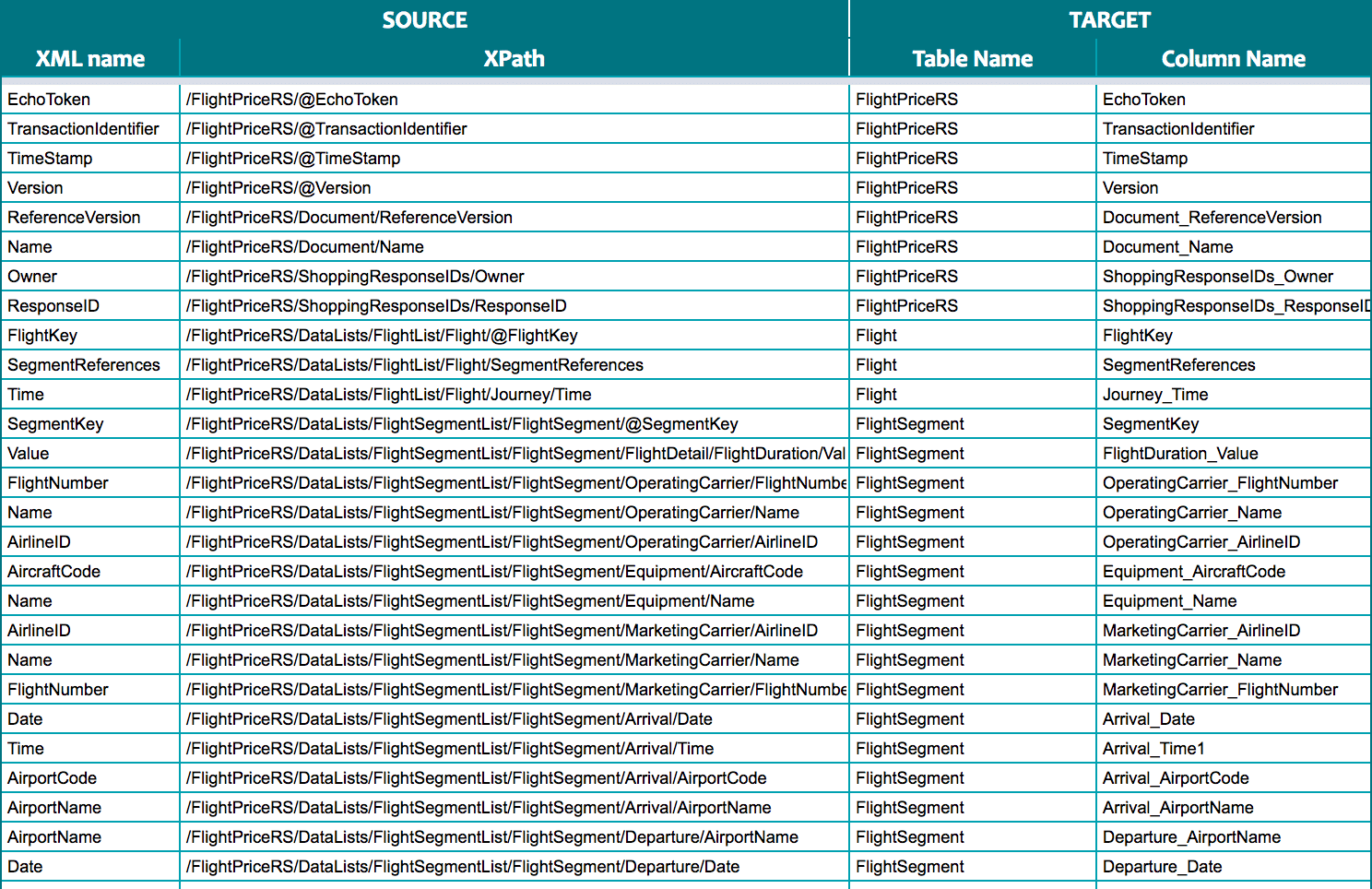
Both data lineage and the optimized target schema make it easy and fast to query, analyse, and visualise our flight data for downstream data analytics and reporting.
SELECT r.fileName, r.fileSize, r.fileModTS, f.flightKey, f.journey_time, f.segmentReferences
  	,fs.departure_airportCode, fs.departure_date, fs.departure_time1
  	,fs.arrival_airportCode, fs.arrival_date, fs.arrival_time1
  	,fs.operatingCarrier_name, fs.equipment_name, fs.marketingCarrier_flightNumber
  	,pfo.timeLimts_offrExprtn_timestamp
  	,a.currencyAmountValue
  FROM FLIGHTPRICERS r
  JOIN FLIGHT f ON f.fk_flightpricers=r.pk_flightpricers
  JOIN FLIGHTSEGMENT fs ON fs.fk_flightpricers=r.pk_flightpricers
  JOIN PRICEDFLIGHTOFFER pfo ON pfo.fk_flightpricers=r.pk_flightpricers
  JOIN FARECOMPONENTTYPE fct ON fct.fk_parent=pfo.pk_pricedflightoffer
  JOIN DETAIL1 d ON d.fk_parent=fct.pk_farecomponenttype
  JOIN AMOUNT a ON a.fk_parent=d.pk_detail
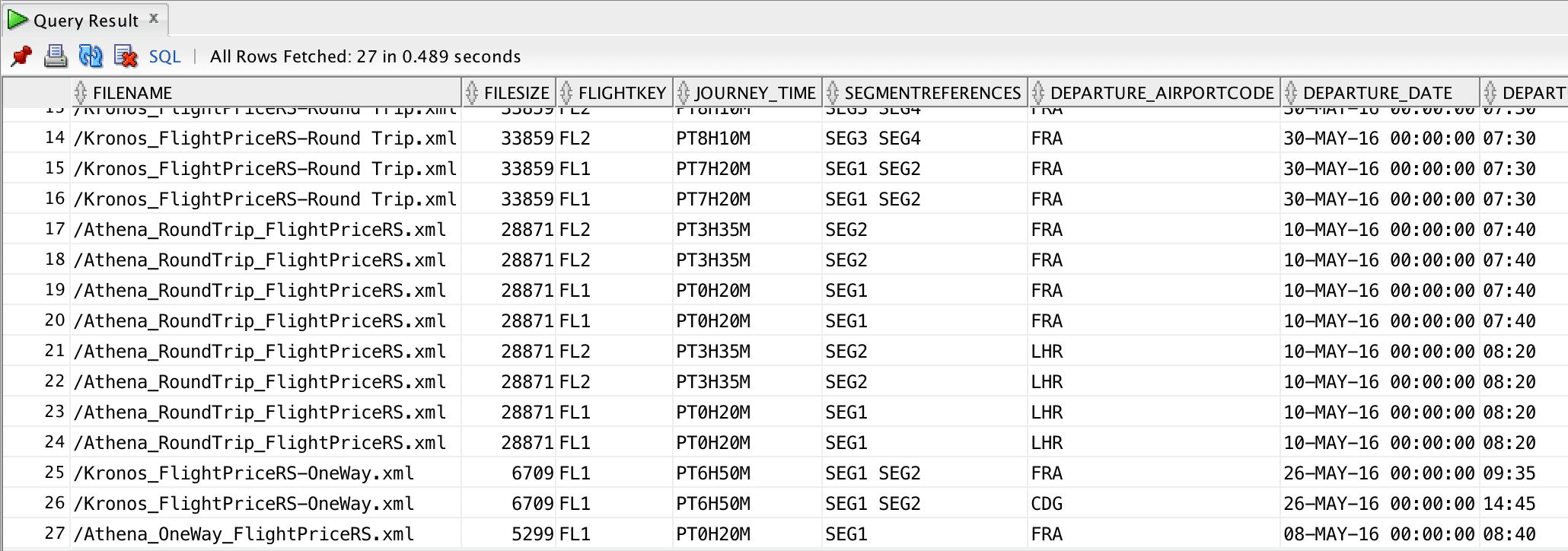
One last thing to notice is the extra columns Flexter generates that allow querying of some of the metadata, like source filename, size, last modification timestamp etc… which might be very useful for XML content validation, reconciliation, troubleshooting etc…
Which data formats apart from XML also give you the heebie jeebies and need to be liberated? Please leave a comment below or reach out to us.